Pool Fill-In and Removal Questions Answered From City Rules
Filling in a pool in California needs a city permit, and the rules differ: the Los Angeles backfill bulletin allows a shell to stay only for landscaping on gentle ground, while Stockton's form BLDG-0014 sets out a $97.25 permit with two methods.
Every answer below comes from a California city, county or state source, linked in the sentence that uses it. Where no California source exists, the answer says so.
Filling in a pool under California permit rules
Is a permit needed to remove a pool in California?
Yes, in every city whose handout was read. Los Angeles and Long Beach use a grading permit; San Diego, Riverside and Fontana a demolition permit; and San Jose, Irvine and Stockton a building permit. The Los Angeles Department of Building and Safety sets its backfill rules in bulletin P/BC 2026-111, and San Diego's Development Services Department in Information Bulletin 710. San Francisco publishes no pool rule, but its Building Code section 106A requires a permit to remove any regulated structure.
Who is licensed to remove a pool?
Cities differ on the licence classes they accept. San Diego names the A and C-21 classes, Stockton names A, C-12 or C-53 for its shell-in-place option, and Fresno names C-12 or A. The state licence board's classification guide describes each class. Because the work needs a permit, the state's $1,000 unlicensed-work exemption does not apply, as Industry Bulletin 24-07 explains. Accepted classes differ from city to city, so the city's own handout or a call to its building department settles it for a given job.
Can a homeowner pull the permit?
Yes in San Diego, Fresno and Stockton, where an owner-builder may apply; in Stockton that covers Option A, the partial fill-in. An owner-builder takes on the contractor's responsibilities, including the inspections and, where required, hiring the soils engineer.
How can a contractor's licence be checked?
The Contractors State License Board lookup shows whether a licence is current and active, which classes it carries and whether a workers' compensation policy is on file. Every licence number on this directory was checked there on 11 October 2026.
Methods and building afterwards
What is the cheapest way to remove a pool?
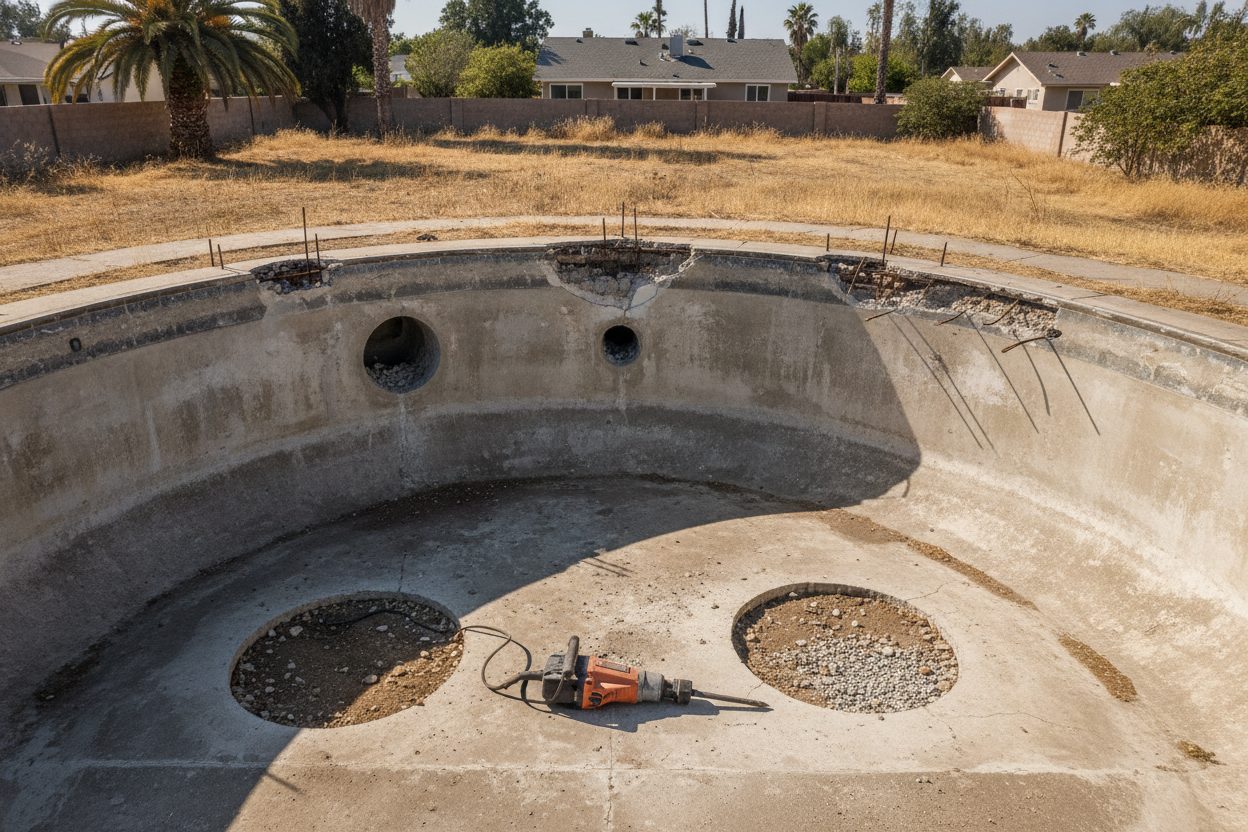
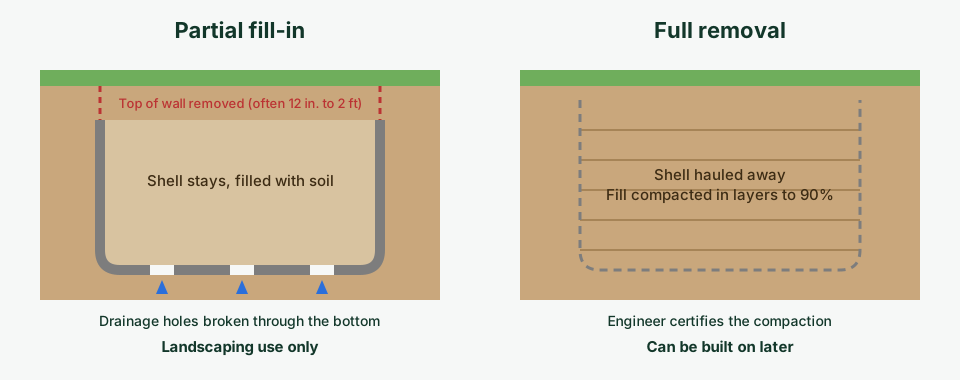
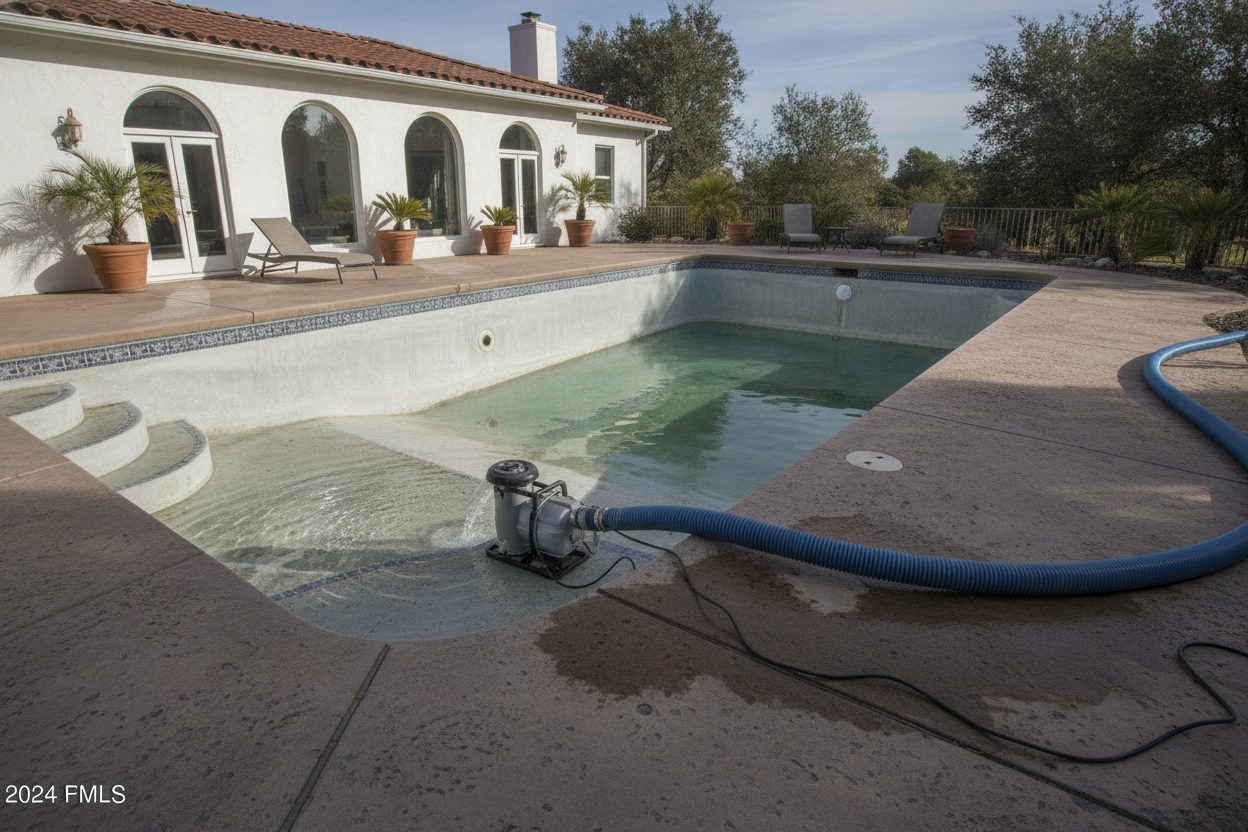
A partial fill-in. The trade-off is that the area is limited to landscaping, and some cities record that against the property. The Los Angeles bulletin allows a shell to stay only for landscaping use on ground sloping 10% or less, and Long Beach's bulletin IB-008 requires two 24-inch holes and a recorded covenant.
Should a pool be filled in or removed fully?
The answer turns on whether anything will be built there later. Stockton's form BLDG-0014 sets out the choice most clearly: Option A leaves the shell with four holes and the top two feet removed, and Option B removes it with engineered fill. Option A suits a garden; Option B suits a future accessory dwelling unit, addition or slab.
Can a house be built over a filled-in pool?
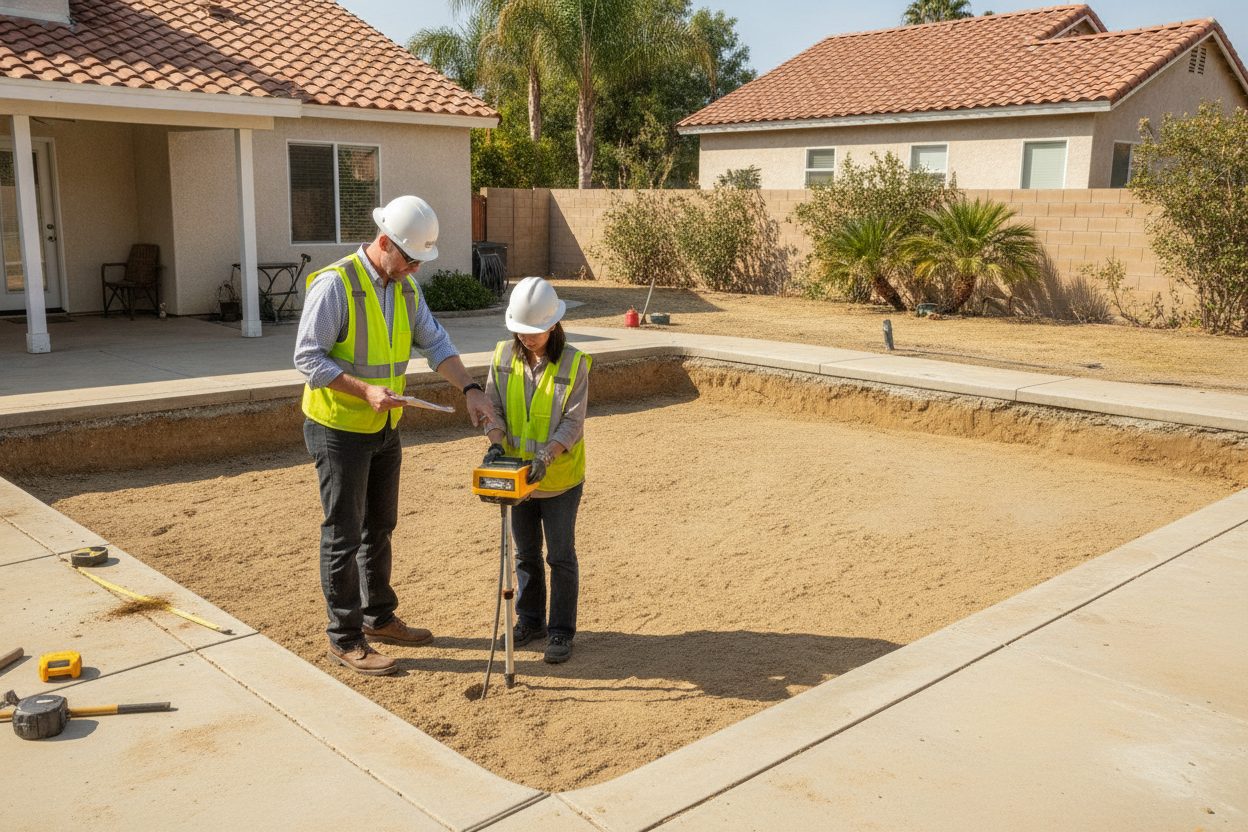
Only where the shell was removed and the fill was compacted to 90% and certified by an engineer. Fontana's pool demolition handout and the Los Angeles bulletin say so directly. San Jose's pool demolition page marks the area non-buildable unless an engineer certifies the compaction.
How many holes go in the bottom of a filled pool?
Between two and six or more, depending on the city. Long Beach requires two 24-inch holes, Stockton four, Santa Ana five 3-ft holes, and Fontana six 1-ft openings. Los Angeles asks for 12-inch holes every 8 ft and San Bernardino 12-inch holes every 6 ft. Fresno requires the entire bottom broken out.
What fill goes into a pool?
Broken concrete from the walls usually goes in the bottom on a partial fill-in, with clean soil above it. Garden Grove's 2026 bulletin adds 12 inches of rock under the soil. A full removal takes 80 to 150 cubic yards of clean fill, placed in layers and compacted to 90%.
Can a pool be filled in with dirt alone?
Not under most city rules. Filling a shell with dirt without breaking drainage holes through the bottom traps water in the old basin, which leads to soggy ground and settling. Every city handout read requires holes or removal of the bottom, and most require the top of the wall removed too: the top two feet in Stockton, San Bernardino and Fontana, and 12 inches below grade in Riverside.
Is partial pool removal allowed in every California city?
No. Ontario's bulletin IB 111 requires the entire shell removed, and Fresno requires the whole bottom broken out. Where partial removal is allowed, cities such as Los Angeles, Long Beach and Moreno Valley limit the area to landscaping or open space.
What happens to the pool equipment and lines?
The pump, filter, heater and lights are removed, and the electrical circuit, gas line and water lines are disconnected and capped. Santa Ana requires separate building, electrical and plumbing permits for that reason under handout BLD-16.
What inspections does a pool removal need?
Most cities inspect at least twice: once after the holes are broken or the shell is removed and before fill goes in, and once at final grade. Cities that require an engineer's compaction report, such as Riverside and Huntington Beach, also need that report before final sign-off. Fremont's express permit is inspection only, with no plan review.
Do homeowners associations have a say?
It can. Irvine's pool removal page notes that a homeowners association may have its own approval process, and that approval is separate from the city permit.
Does the air district need notice?
In San Jose, yes. San Jose's pool demolition page requires a job number from the Bay Area Air Quality Management District before demolition starts, and Lancaster requires an air district demolition notice as well. Elsewhere, the district's rules are written for load-bearing building demolition, so it confirms whether a pool-only job counts.
Cost and timing
What does pool removal cost in California?
California contractors publish $3,500 to $12,000 for a partial fill-in and $8,000 to $30,000 for a full removal in Northern California, and Los Angeles firms start at $10,500 and $17,500. The pool removal cost guide lists every published price with its source.
What does above-ground pool removal cost?
$300 to $3,500, depending on decking, according to Angi. Above-ground pools rarely need a demolition or grading permit.
How long does pool removal take?
One to four days for a partial fill-in and three to seven for a full removal. Permits add one to three weeks in most cities; San Jose's permit center can issue in one visit. Oakland bars grading from 15 October to 15 April.
Water, tax and selling
Where can the pool water be drained?
The rule varies by city. Stockton allows the sewer clean-out only, and Modesto sends all pool water to the sewer, even when dechlorinated. Riverside prefers the sewer clean-out and allows the storm drain only below 0.1 mg/L of chlorine. San Diego and Los Angeles allow the storm drain if the water is dechlorinated and within a set pH range, as the San Diego pools and spas fact sheet and LA Sanitation's guidance for pool owners explain.
Does removing a pool lower property tax in California?
Possibly, by a small amount. The Board of Equalization's letter 86/09 treats removal of an improvement as a reason to reduce assessed value, but the reduction is tied to the pool's own assessed value, so it may be small for an old pool. The San Diego County Assessor handles realty changes, though no county publishes how an owner reports a pool removal.
Does a removed pool have to be disclosed on sale?
The state's seller disclosure form asks about fill on the property and about unpermitted work, as the Department of Real Estate's disclosure booklet RE 6 shows. Long Beach and Santa Clarita also put a record on the property when the shell stays, so a permitted job with a final inspection is the cleanest history to hand a buyer.
Are there rebates for removing a pool?
No statewide programme was found. Valley Water in Santa Clara County pays $2 a square foot, up to $3,000, when a pool becomes low-water landscape, and requires approval before work starts.
Does removing a pool decrease home value?
No California source measures it. Buyers' preferences vary by area and by the age and condition of the pool, and a local real estate agent is the best guide for a specific property.
Do unincorporated areas follow city rules?
No. Homes outside city limits follow the county. Orange County Public Works, for example, publishes its own pool demolition requirements for unincorporated Orange County.
About This Site
Pool Removal California is an independent referral directory. The site is not a contractor and does not remove pools. Listed businesses may pay a referral fee when a homeowner is put in touch with them through the site, and that fee never changes the listing order: contractors with an active state licence appear first. The full referral disclosure and listing criteria explain how each business was checked.